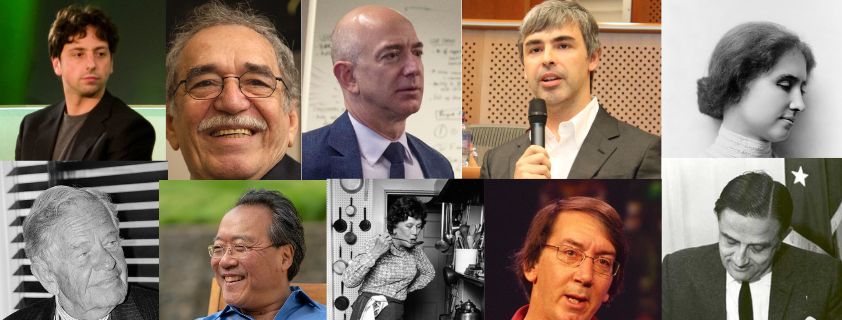
In 2011, the Wall Street Journal noticed something surprising: a huge number of the world’s most creative founders had one thing in common. They all went to Montessori schools.
The article that started it all
In April 2011, Peter Sims wrote a piece for the Wall Street Journal that became one of the most talked-about articles in early education. The idea behind it was simple. And honestly, a bit shocking.
Sims had been studying how the world’s most innovative leaders think. He was drawing on six years of research by professors Jeffrey Dyer (Brigham Young University) and Hal Gregersen (INSEAD), who surveyed over 3,000 executives and spoke to 500 company founders. And they found a pattern that nobody expected: way more of these founders went to Montessori schools than you’d think.
The names on the list? Larry Page and Sergey Brin, who built Google. Jeff Bezos, who built Amazon. Jimmy Wales, who created Wikipedia. Will Wright, who designed The Sims. Sims gave them a catchy label, the “Montessori Mafia”, and suddenly parents everywhere started paying attention.
– Peter Sims, The Wall Street Journal, 2011
So who’s in the “Montessori Mafia”?
It’s not just tech founders. Over the decades, Montessori alumni have gone on to shape everything from science and literature to music and public service. Here are some names you’ll recognise:
Co-founders of Google. Both say it was Montessori, not their professor parents, that shaped how they think.
The Amazon founder was so focused in his Montessori classroom that his teachers literally had to pick up his chair to move him.
Creator of Wikipedia. As a Montessori kid, he spent hours reading encyclopedias, and later built one for the whole world.
Nobel Prize-winning author. His love of storytelling started in a Montessori classroom in Colombia.
The creator of SimCity and The Sims. He called Montessori “the joy of discovery.”
The chef who changed how America thought about food and cooking.
One of the world’s greatest cellists, known for his curiosity across genres and cultures.
Author, activist, and the first deaf-blind person to earn a college degree.
Pioneering paediatrician and Harvard professor who changed how we understand newborns.
Father of India’s space programme and founder of ISRO. Raised on Montessori principles in Ahmedabad.
When Barbara Walters asked the Google founders what made them successful, both Larry Page and Sergey Brin gave the same answer: it wasn’t Stanford, and it wasn’t their parents. It was their Montessori school.
The India connection is deeper than you’d think
Here’s something most parents in Chennai don’t know: Montessori education has roots in India that go back over a hundred years. Maria Montessori herself lived and worked in India for nearly eight years, from 1939 to 1946, and again from 1947 to 1949. That’s longer than she spent in any country outside Italy.
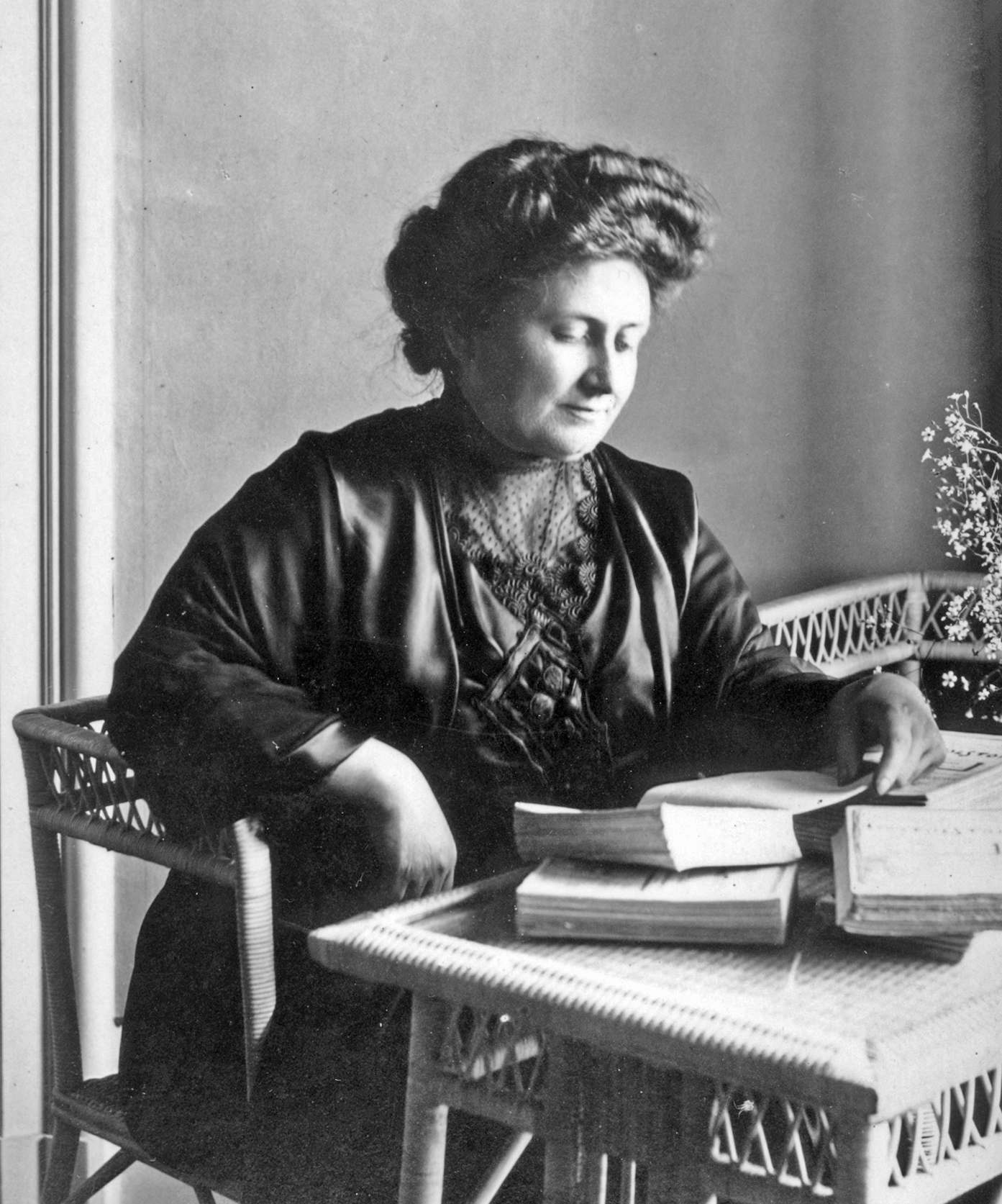
Italian physician and educator who created the Montessori method. She spent nearly eight years in India, more than any other country outside Italy.

Nobel laureate, poet, and educator. He started “Tagore-Montessori” schools and was an early supporter of the Montessori movement in Asia.
She came to India in 1939, invited by Dr. George Sydney Arundale of the Theosophical Society and his wife Rukmini Devi. She settled in Madras (now Chennai) and ran her first Indian training course right here in Adyar. During her years in India, through the Second World War and beyond, she developed some of her biggest ideas, including “Cosmic Education” and the thinking that became her famous book, The Absorbent Mind.
Two great minds, one big idea
India’s connection to Montessori runs through some of its most brilliant thinkers. Rabindranath Tagore hated the rote learning he’d grown up with, so he built his own school at Shantiniketan in rural Bengal. By 1929, he had started several “Tagore-Montessori” schools across India, combining her scientific approach with his own love of nature, art, and creative freedom. Tagore also became one of the first sponsors of the Association Montessori Internationale (AMI), giving the movement real credibility across Asia.
When Montessori visited Shantiniketan in 1939, she said she was “in complete sympathy” with Tagore’s philosophy. Two people, from two different continents, who had arrived at the same truth: children learn best when you trust them, respect them, and give them room to discover.
Mahatma Gandhi visited Montessori schools in Europe in the 1930s and saw in her method a way to raise self-reliant thinkers, exactly the kind of citizens a free India would need. And the Sarabhai family of Ahmedabad raised their eight children on Montessori principles. One of them, Vikram Sarabhai, went on to found ISRO and launch India’s space programme.
Today, the Indian Montessori Foundation (IMF) works to keep AMI Montessori training authentic across the country. And Chennai holds a special place in this story: this is where Maria Montessori trained a whole generation of Indian educators who carried her method to every corner of the subcontinent.
Maria Montessori spent 8 years in Chennai, longer than in any other country outside Italy. The very first AMI training course in India was held right here in Adyar.
How Montessori builds strong readers (and confident communicators)
If you’ve ever wondered how a 4-year-old in a Montessori classroom ends up reading before anyone “taught” them to read, you’re not alone. It surprises a lot of parents. But it’s not magic. It’s method.
In a traditional classroom, children learn letters by rote: “A for Apple, B for Ball.” They memorise shapes and sounds separately, and reading comes later, almost as a separate subject. In a Montessori classroom, it works differently. Children start by feeling letters: tracing sandpaper letters with their fingers while saying the sound. They’re using their eyes, their hands, and their voice all at the same time. The brain makes much stronger connections this way.
Then comes the moveable alphabet: loose wooden or plastic letters that children use to build words before they can even hold a pencil properly. They’re writing words at age 3 or 4, sounding them out, experimenting. Nobody’s correcting them with red ink. They’re just playing, and learning, without realising it.
Here’s the thing that matters for you as a parent: this isn’t about rushing your child to read early. It’s about respecting the moment when they’re ready. Every child has a window (usually between ages 3 and 5) when their brain is wired to absorb language like a sponge. Montessori is designed to catch that window and make the most of it.
And language in Montessori isn’t a separate “period” on a timetable. It’s woven through everything. When a child sorts animal figures by habitat, they’re building vocabulary. When they describe what they built with blocks, they’re practising sentences. When they listen to a story and retell it to a friend, they’re developing comprehension, without a worksheet in sight.
Research backs this up. Studies show that Montessori children tend to have stronger vocabulary, better phonetic awareness, and deeper reading comprehension compared to children in conventional settings. And in India, where children often need to become confident in both English and their mother tongue, this kind of natural, immersive language learning gives them a genuine head start.
Think about the difference: in a traditional classroom, a child who encounters a difficult new word waits for the teacher to explain it. A Montessori child? They’ll sound it out, look for clues, maybe ask a friend, maybe grab a picture card. They’ve learned to figure it out. That confident reader becomes a confident learner, in any school, any subject, any language.
What does the research actually say?
The Dyer-Gregersen study wasn’t just a bunch of interesting stories. When they looked across hundreds of interviews with innovative founders, they found the same traits coming up again and again: a comfort with experimenting, a habit of asking “why?”, and the ability to figure things out on their own. These aren’t skills that most traditional schools focus on. But they’re exactly what a Montessori classroom is built to develop.
There’s harder evidence too. In 2006, a study published in the journal Science (one of the most respected research journals in the world) followed children in Milwaukee who were randomly assigned (by lottery, so there was no selection bias) to either Montessori or regular schools. By the end of kindergarten, the Montessori kids had stronger reading and maths skills, better ability to focus and manage their time, and more advanced social skills than their peers. Because the children were assigned randomly, this is some of the strongest evidence we have that Montessori actually works. It’s not just that “certain families” choose Montessori.
And remember those Google founders? When Barbara Walters asked Larry Page and Sergey Brin what made them successful, they didn’t talk about Stanford or their PhD parents. Both gave the same answer: their Montessori education. They said it taught them to be self-motivated, to question how things work, and to think for themselves.
– Larry Page, Co-founder of Google
So what is it about Montessori that works?
Montessori doesn’t teach children to become entrepreneurs. It does something more basic and more powerful: it teaches children to trust their own curiosity.
In a Montessori classroom, children choose what they want to work on. They work at their own pace. They learn through real materials they can touch and move, not worksheets. And they get long, uninterrupted blocks of time to concentrate, instead of being shuffled to a new activity every 30 minutes.
What this builds is what psychologists call “intrinsic motivation”: the drive to learn because you want to, not because there’s a test or a gold star. Research has shown, again and again, that this quality is one of the strongest predictors of creative achievement later in life.
Will Wright, the game designer, put it simply: Montessori taught him “the joy of discovery.” He said it showed him that you can become fascinated by complex ideas just by playing with blocks. It’s about learning on your own terms, not waiting for someone to explain things to you.
Will my child adjust to “regular” school after Montessori?
Let’s talk about the question every Chennai parent asks. We hear it a lot: “Montessori sounds wonderful, but will my child cope when they move to a CBSE or ICSE school in Class 1?”
It’s a fair question. And the short answer, backed by research, is: yes, and usually better than their peers.
Here’s why. By the time a Montessori child reaches age 5 or 6, they’ve spent years practising skills that most children only start developing in primary school. They can sit and focus on a task for extended periods, not because someone told them to, but because they’ve done it hundreds of times by choice. They know how to manage their time. They know how to ask for help when they need it. And they know that learning takes effort. It’s not always easy, and that’s okay.
Think about what happens in a traditional Class 1 classroom. Children are expected to sit still, follow instructions, work independently at times, and manage their own materials. A child who’s been in a teacher-centred preschool, where someone always tells them what to do next, often struggles with this. A Montessori child? They’ve been doing exactly this since they were 3.
There’s another advantage that’s less obvious. Montessori children are less dependent on external rewards like grades, stars, and praise. They’ve learned to feel satisfied by the work itself. In formal school, this becomes a superpower. While other children might lose motivation when the praise stops, Montessori kids keep going because they’ve built an inner drive.
And here’s something practical: many of the top CBSE and ICSE schools in Chennai actually prefer Montessori-trained children for admission. Why? Because these children come in with strong reading foundations, good social skills, and the ability to work both independently and in groups. They’re ready.
The truth is, Montessori doesn’t prepare your child for one particular system. It prepares them to do well anywhere, whether that’s a traditional school, an international school, or anything in between. The habits they build in those early years (curiosity, focus, independence, resilience) are the same habits that serve them in Class 1, Class 10, and well beyond.
What this means for your child
The “Montessori Mafia” story isn’t about producing the next Jeff Bezos or building the next Google. It’s about something quieter and honestly more important: the kind of person your child becomes when they’ve spent their earliest years in a place that respects their intelligence, trusts their instincts, and gives them room to figure out who they are.
What the research tells us is that Montessori children tend to develop stronger problem-solving skills, better social reasoning, deeper concentration, and, most importantly, a genuine love of learning that doesn’t fade after preschool. These aren’t things you can test with a flashcard. They’re things that show up in a life.
We can’t predict what the world will look like when our children grow up. But we can give them the foundation to navigate it: with curiosity, with confidence, and with the independence to make their own way. That’s what Montessori is designed to do. And that’s what the “Montessori Mafia” story is really about.
– Dr. Angeline Lillard, Montessori researcher, University of Virginia
Key Takeaways
- The founders of Google, Amazon, and Wikipedia all credit their Montessori education, not elite universities or famous parents, for their success.
- Montessori builds the skills that matter most: curiosity, focus, independence, strong language foundations, and a love of learning that lasts a lifetime.
- Montessori children transition smoothly to formal CBSE/ICSE schools, and often outperform peers who went through traditional preschools.
Curious about Montessori for your child?
Visit Kidoz Montessori in Perumbakkam (OMR), Chennai, and see our prepared environment for yourself. We welcome children aged 1.5 to 6 years. Every child deserves a Montessori start.